

Malaysia's Property Market Broke a Record — So Why Are Developers Panicking?
Let me guess. You saw the headline. "Malaysia property hits record RM241 billion in 2025!" and you thought — wah, market so good?
Hold on. Let's slow down and actually look at what's happening. Because the full picture is a lot more interesting than the headline.
The Record Is Real. But It's Not the Whole Story.
Yes, Malaysia's property market hit RM241.87 billion in total transaction value in 2025. That's the highest in a decade. That part is true, confirmed by JPPH (the government's official property data body).
But here's what the headline didn't tell you — the number of transactions actually dropped by 1%. Fewer deals were done, but at higher prices. That's not a boom. That's a market where prices are climbing but fewer people can actually afford to buy.
Two very different things.
Crowded EXSIM Showroom at Hextar World on March 7, 2026 taken by Jay Lim.
Then Why Are Developers So Stressed Right Now?
Because at the same time that record was being celebrated, developers were quietly sitting on a mountain of unsold units.
Rehda — the Real Estate and Housing Developers' Association — surveyed 166 developers across Peninsular Malaysia in early 2026. Here's what they found:
60% of developers have unsold completed units sitting on their hands
In H2 2025, developers launched 17,971 units but only sold 3,784 of them
That's a take-up rate of just 21%. Meaning nearly 8 out of every 10 units launched — didn't sell
Earlier in 2025, developer confidence was already shaky — only 19% of developer executives were optimistic about the market, down from 51% just six months before. That's a massive drop in confidence.
So yes, the market "broke a record." But the people actually building homes are struggling. Does that make sense? Actually it does — once you understand where the real problem is.

The Real Culprit: Banks Are Saying No, and…
Here's the part nobody's talking about loudly enough.
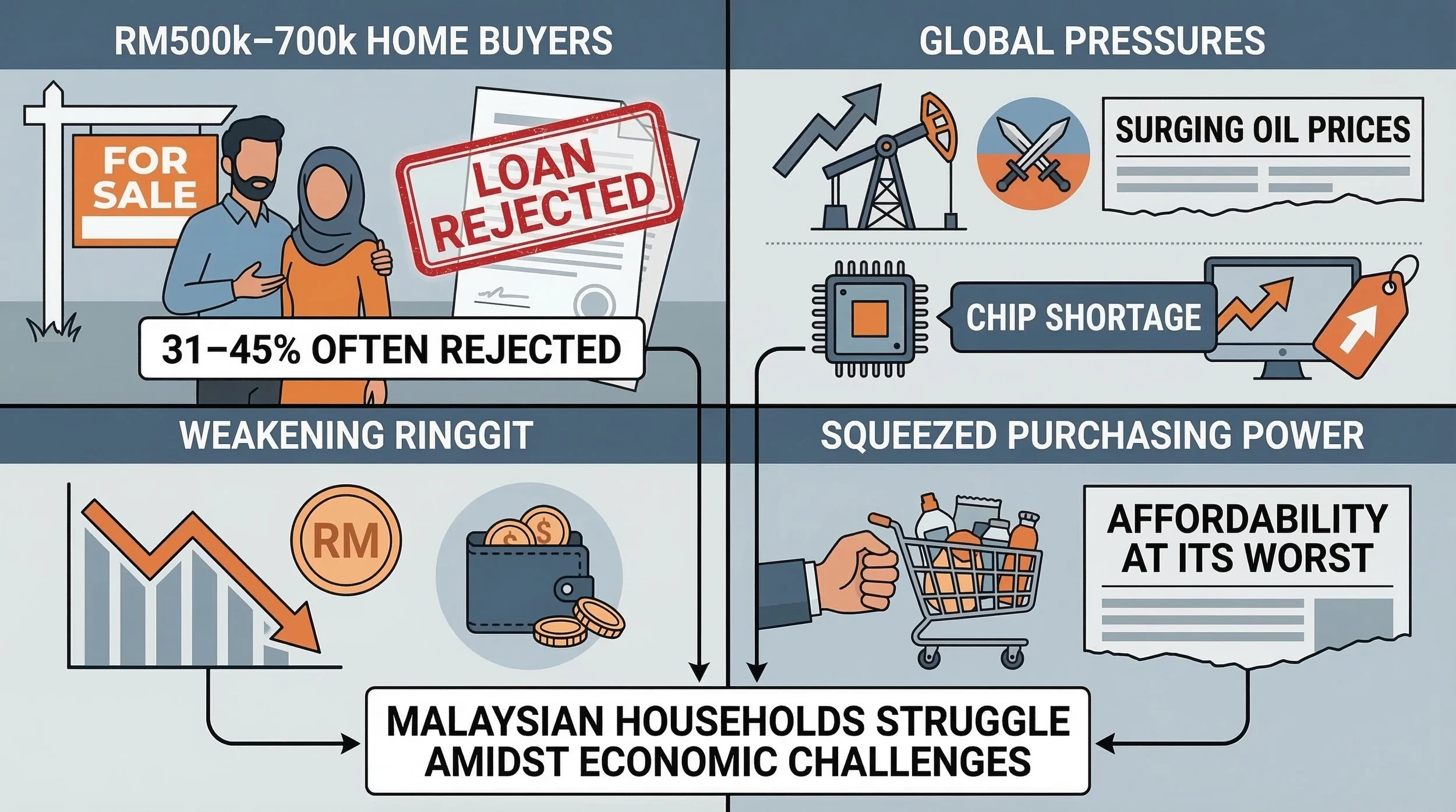
Rehda's president Datuk Ir Ho Hon Sang said it plainly at their March 2026 press conference: in the RM500,000 to RM700,000 price range, loan rejection rates are sitting at 31% to 45%.
Read that again.
If you and 10 of your friends all tried to get a bank loan for a RM600,000 property, between 3 to 5 of you would walk out empty-handed. Not because the property is bad. Not because you don't want to buy. The bank just said no.
Why? Banks are flagging buyers for income ineligibility, bad credit history, or incomplete financial documents. And with household debt in Malaysia sitting at around RM1.65 trillion as of early 2025, banks are being extra cautious.
This is why developers can't sell. The demand is there — people want to buy. But they can't convert that want into a transaction because financing keeps falling through.
Just when you thought it was complicated enough locally, the global situation is adding more pressure.
Oil prices shot up after conflict disruptions in the Middle East pushed crude up by $20 per barrel to around $92/bbl. For Malaysia, this means higher fuel costs, potential subsidy strain, and rising prices for goods and services across the board.
AI is causing a chip and memory shortage. The global rush to build AI infrastructure has created a worldwide scramble for semiconductors. Memory prices have doubled in some categories since early 2026. Your next laptop, phone, or GPU is going to cost more. And it's expected to last until at least late 2027.
Combined, this is a cost-of-living squeeze that hits Malaysian households right in the wallet. When your monthly expenses go up, your ability to service a home loan goes down. Banks know this — which is partly why approval rates are tightening.
What Does This Mean If You're Looking to Buy?
Good news, actually — if you're financially prepared, you're in a strong position right now.
Developers with unsold completed stock are quietly cutting deals. We're talking 15–30% discounts off listed prices, free full-furnishing packages, and developers absorbing your stamp duty costs. These aren't advertised loudly. You have to find it. But remember, these are just hearsay. Contact us to know the official deals and promotions:
What i would try? Look for developer units that are completed and VP has been initiated. The best part about this is that you actually get to look at the real completed unit condition and facing, instead of relying on the brochure and imagination.
A few things to get right before you start shopping:
1. Get your loan pre-approved first. Don't fall in love with a unit and then find out the bank rejects you. Know your number before you go looking.
2. Target the RM300,000–RM500,000 range if you can. First-time buyers still get full stamp duty exemption on properties up to RM500,000, extended until 2027. That alone saves you tens of thousands.
3. Check if you qualify for the Housing Credit Guarantee Scheme — the government put aside RM20 billion specifically to help buyers who struggle with bank financing. Worth looking into.

What About If You're Trying to Sell?
This is where it gets uncomfortable — because if you're a seller in an oversupplied area, the market is not your friend right now.
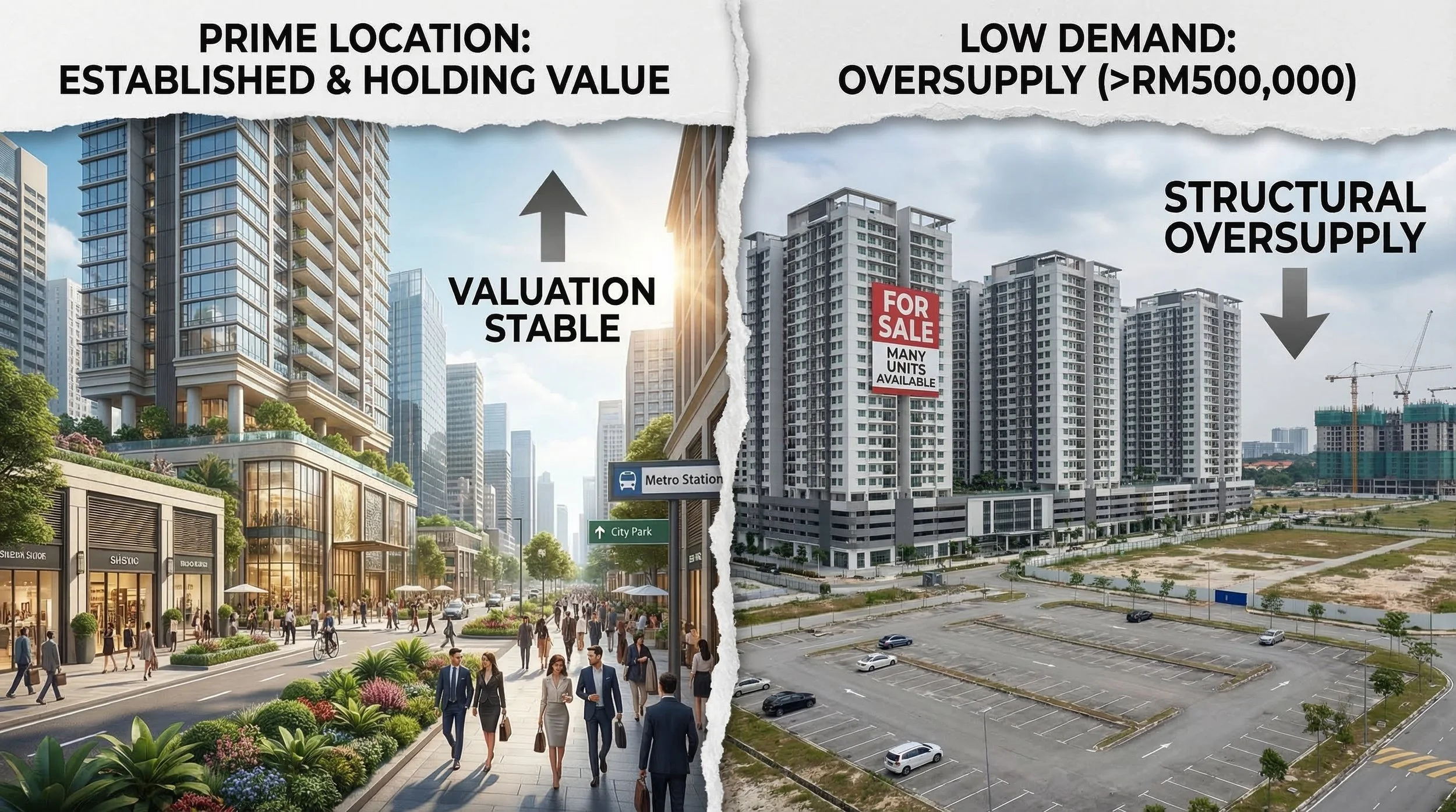
Prime locations — near MRT, LRT, in mature established suburbs — are still holding value. If your property is there, you're okay.
But if you're sitting on a high-rise unit in a fringe area, or a new development in oversupplied corridors, you're competing against developers who are offering discounts, free furniture, and absorbed stamp duty. That's very hard to beat as a private seller.
The honest advice? Price it right upfront. Don't start high hoping to negotiate down. Overpriced listings in a slow market just sit there, while buyers scroll past to the next one. However if you are not rushing to sell, then you can try your luck to wait until the demand increases, but keep in mind, new projects are always developing nearby, creating more competition and supply as time goes by.

So Is This Malaysia's Moment For Foreign Buyers?
Ironically — yes. And here's why. But before that, lets take a step back at the requirement.
Foreigners are required to purchase property units at these minimum prices depending on state land:
Generally RM 1,000,000 for residential homes.
Selangor: RM 2,000,000 for landed/strata in Zone 1 & 2; RM 1,000,000 in Zone 3.
Penang: RM 1,000,000 (mainland) to RM 3,000,000 (island, landed).
Johor: RM 1,000,000 (strata/non-international zone), RM 2,000,000 (landed/international zone).
Sarawak: RM 500,000
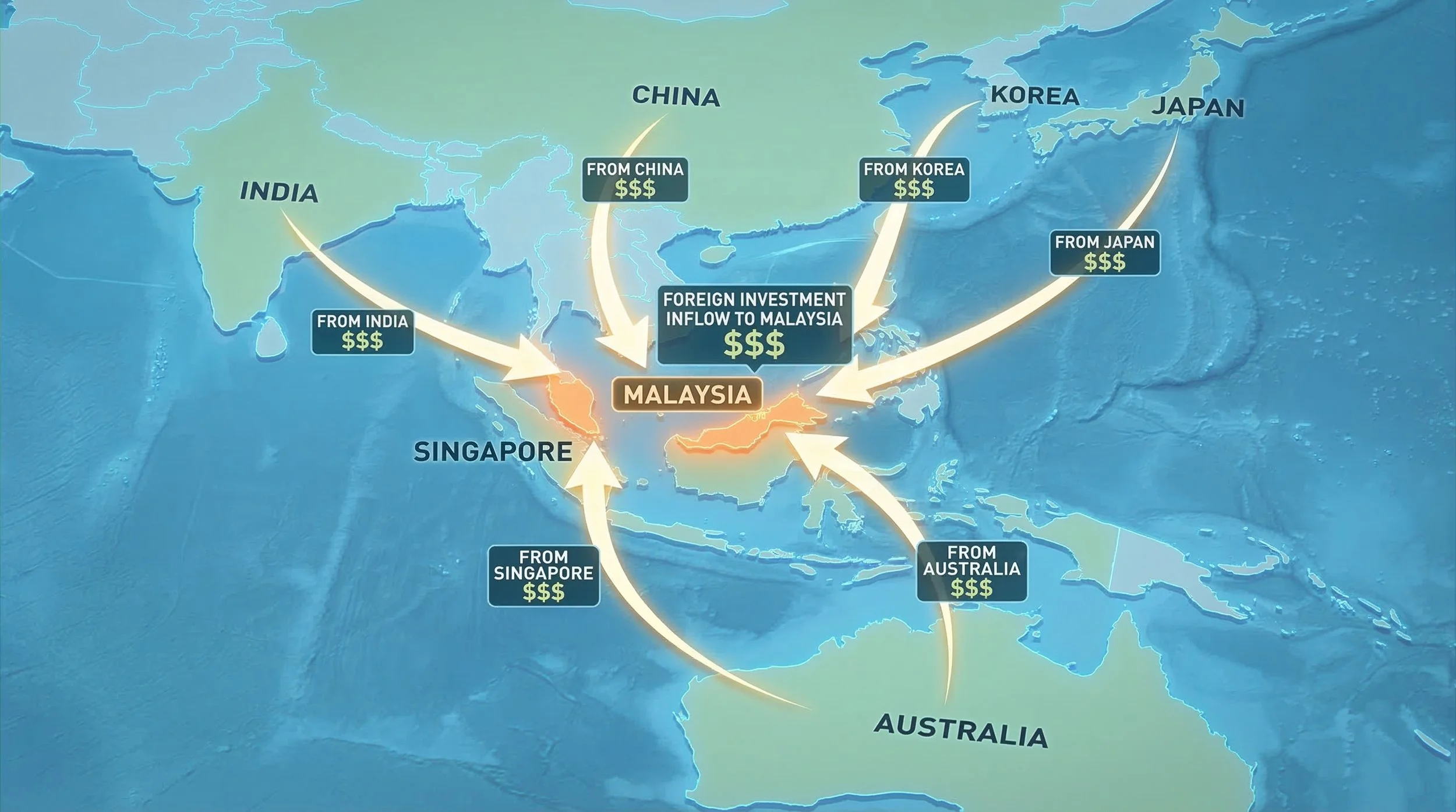
These are usually high valued properties where locals - generally having lower purchasing power - may look away from these units. As the demand decreases, there are possibilities that the value decreases or rebates are thrown in, as mentioned above. If you are a foreigner who are looking to invest in Malaysia and targeting Malaysian properties, do reach out to us and we will set you up!
Rental yields in Kuala Lumpur are running at 4.5% to 6%, which is genuinely competitive for a capital city. Penang has a quality-of-life story that keeps attracting expats. And Johor Bahru — with the RTS Link to Singapore due by end of 2026 — is one of the most watched corridors in Southeast Asia right now.
But if you're a foreign buyer, note this: starting January 2026, there's a flat 8% stamp duty on residential property transfers by non-citizens. Add in other closing costs and you're looking at 9–13% in transaction costs on top of your purchase price. That's not a dealbreaker — but it has to be factored in.
The Bottom Line
The record headline was real — but it papered over a market that is genuinely bifurcated. Established locations are holding. New launches and oversupplied corridors are hurting. And with global headwinds squeezing household incomes, the pressure on affordability isn't going away soon.
If you're a first-time buyer with clean financials and patience — this might actually be your best window in years. The deals are there if you know where to look and how to ask.
If you're a seller — price it honestly from the start, because buyers today are smarter and have more options than ever.
And if you've been sitting on the fence? The fence is getting less comfortable by the month.
Sources: JPPH Property Market Report 2025 (Feb 2026), Rehda Property Industry Survey H2 2025 (Mar 2026), Malay Mail, The Edge Malaysia, EdgeProp, The Star / Bernama.
